After about half a month of price recovery thanks to the information and psychological effects, the price of live pigs in the North has dropped sharply to 32,000 - 35,000 VND/kg, while the African swine fever (ASF) epidemic continues to spread complicatedly and it is not known when it will be eliminated, so in this difficult period, you must be truly professional before thinking about pig farming.
According to the latest announcement from the Department of Animal Health, as of April 16, there were 23 outbreaks in 7 districts of 7 provinces and cities nationwide that had passed 30 days. Of which, Hoa Binh and Bac Kan were the first two provinces to announce the end of African swine fever. Thus, there are still more than 20 provinces and cities nationwide with outbreaks of African swine fever that have not passed 30 days.
*Image from Anova Farm
However, it must be said that although the spread of African swine fever from one province to another is slowing down in terms of data, the rate of spread from one district to another, from one commune to another in the provinces that have announced the epidemic is still very strong, with no signs of cooling down. We must acknowledge the efforts of all levels of government and the livestock and veterinary systems from central to local levels in the fight against the epidemic in recent months. After a period of confusion and fear at first, the work of disease prevention has initially shown positive signs.
For example, Thai Binh province, the first locality to announce African swine fever in early February 2019, has now spread to all 8 districts and cities of the province with thousands of pigs destroyed. Currently, on average, Thai Binh province still has to destroy several dozen tons of pigs that died or tested positive for African swine fever every day.
Up to now, in some districts of Hai Phong City, African swine fever has basically covered communes such as Thuy Nguyen, Kien Thuy, Vinh Bao... At the commune level, it is similar, such as Chinh My, the first commune of Thuy Nguyen district to detect an outbreak, up to now, all 12/12 villages of this commune have had African swine fever and counting and destroying pigs infected with African swine fever has become a daily task for some local leaders.
In Hai Phong City, since the announcement of the first African swine fever outbreak on February 22 in Chinh My commune, Thuy Nguyen district, by April 22, according to statistics from the Department of Animal Husbandry and Veterinary Medicine of Hai Phong, African swine fever has broken out in 131 communes and wards in 10 districts.
Similarly, by mid-March 2019, all 10/10 districts and cities of Hung Yen province had African swine fever, just over a month after the first outbreak in the province. The total number of pigs culled due to African swine fever in Hung Yen up to this point has reached tens of thousands.
Other provinces and cities in the Red River Delta have suffered the same fate when the epidemic basically covered the whole area, including Nam Dinh, Ha Nam, Hai Duong, Ninh Binh, Bac Ninh... In some places, pigs have even died and been culled almost completely. However, the most worrying thing is that not only small-scale livestock households and farmers are infected, but also large farms, sow farms worth billions of VND of some businesses and pig farmers have begun to be sporadically invaded and attacked by African swine fever, showing the increasing danger and severity of this disease without vaccine or cure.
Only biosecurity has a chance to survive
Although it has been widely publicized, we still have to warn again that African swine fever is not contagious and is dangerous to humans and other animals, but it is extremely dangerous to pigs. It is dangerous because the world's modern medicine has not yet successfully researched an African swine fever vaccine, and there is no effective treatment regimen or antibiotic for the ASF virus, although this disease was first discovered in 1920 in Kenya, Africa.
In particular, the ASF virus can survive for a very long time in the environment or in the host, spreading through many sources and many different methods with a mortality rate of up to 100% when infected, so when pigs are infected with the ASF virus, from Europe to China or Vietnam, the only way is to destroy them.
Our warning is not to make pig farmers too pessimistic or discouraged, but to help farms, people, and businesses determine the scale and method of their farming path ahead in order to survive in the current precarious situation.
In reality, ASF is spreading much faster in the plains than in mountainous and remote areas. In particular, although some large farms have been affected by the epidemic, there are also farms located right next to the epidemic or have been surrounded by the epidemic for many months, but up to now, they are still safe, proving that if we strictly follow the highest biosecurity and veterinary hygiene, we can still live safely with ASF.
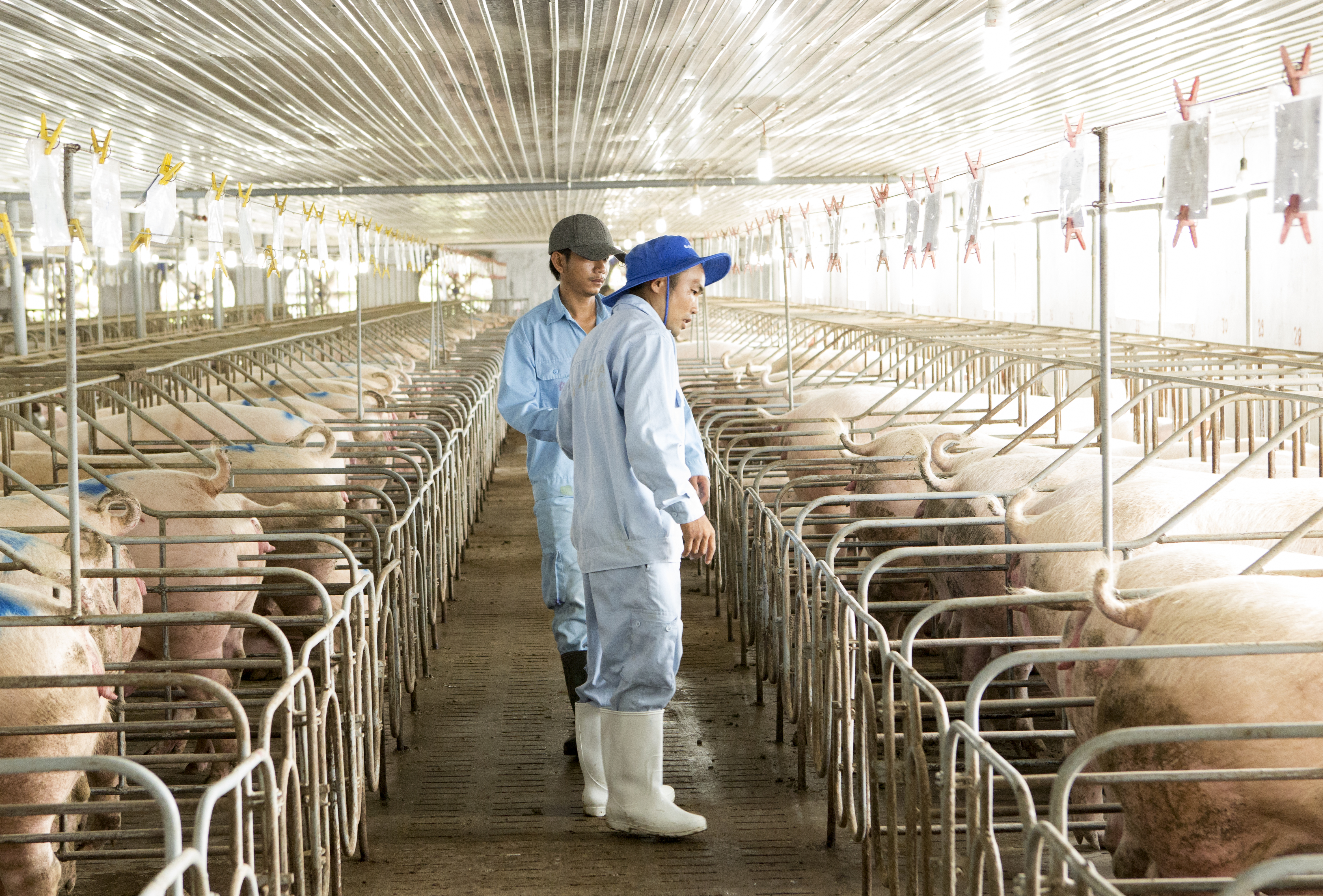
*Image from Anova Farm
Through research, we know that currently, large pig farming enterprises in Vietnam have raised biosecurity in their farm systems to the highest level. Even Dabaco and C.P Vietnam are stretching nets and curtains on all pig farms to prevent flies, mosquitoes, and rats from entering the farms. The sprinkling of lime powder, spraying disinfectants, disinfecting vehicles, isolating and banning farms is strictly implemented, no different from security control for heads of state.
Sharing with us, Professor Jeroen Dewulf, from Ghent University (Kingdom of Belgium) noted that recent research results from scientists from Europe have proven and confirmed that the African swine fever virus is not transmitted through the air but is mainly transmitted through direct or indirect contact with the pathogen.
Studies have also shown that the ASF virus is not much affected by weather such as rain, sun, cold, and seasonal heat. In fact, the ASF virus exists in almost all types of weather in the hemisphere, so farmers should not expect the disease to cool down in the hot summer.
Professor Jeroen Dewulf demonstrated that after 6 months of testing, scientists still found live ASF virus in the remaining body parts of the pig, so the survival time of the ASF virus could be longer if there is a host.
Therefore, while waiting for an ASF vaccine at an acceptable price, Professor Jeroen Dewulf advised farmers in Vietnam to proactively improve biosecurity to the highest level, because countries with the most modern livestock in Europe today such as Belgium, Spain, Poland... also only have the technical solution of biosecurity to deal with African swine fever.
In Vietnam, if farmers do not feel confident about the biosecurity of their pig farms, the best solution and advice from experts at this time is to prioritize holding cash. Because with the small-scale livestock farming system that permeates residential areas like in Vietnam, along with the uncontrolled pig slaughter system, and the ASF epidemic that is spreading everywhere like sticky rice like beans, preventing African swine fever in the household livestock sector is an impossible task.
Although it is very difficult, the opportunity for the pig farming industry is not necessarily over, but the current and future game when having to live with ASF, perhaps only truly professional breeders have enough resources, means, knowledge, and experience to continue. Because the current situation of African swine fever spreading in the past few months shows that small-scale pig farms and households in our country do not meet the criteria for biosafety even at the smallest level.
Nguyen Huan - Truong Giangang
Agriculture