Healthy sows were vaccinated and allowed to live with infected pigs. After more than two months, they were still healthy and gave birth.
At the meeting on "Solutions for using vaccines and biological products" organized by the Ministry of Agriculture and Rural Development on the morning of July 2, Professor Nguyen Thi Lan, Director of the Vietnam Academy of Agriculture, said that Vietnamese scientists had isolated PAM cells to produce a vaccine against African swine fever and were researching to multiply them in large quantities.

Professor Nguyen Thi Lan reported on the initial results of the research.
Four months ago, the Academy began researching four types of African swine fever vaccines, including inactivated vaccines (tested in the laboratory), traditional attenuated vaccines (viral strain creation techniques have been performed, molecular biology testing is underway), natural attenuated vaccines (natural strain selection is being screened), and vaccines using gene deletion technology (research is underway).
With inactivated vaccines, the research team successfully isolated and selected a number of virus strains, selected the vaccine production environment, and identified highly virulent virus strains to evaluate the quality of the vaccine. "The initial results were good in a small-scale laboratory setting," said Professor Lan.
The research team tested the vaccine on Mr. Trinh Vu Trinh's (Hung Yen) pig herd with 14 sows from April 18 and repeated the second injection on May 12. After eight weeks, the 13 sows were still in normal health, ate well, and gave birth, while one piglet died of swine fever after the first injection.
Testing healthy pigs and keeping them together with sick pigs showed that vaccinated pigs were not infected.
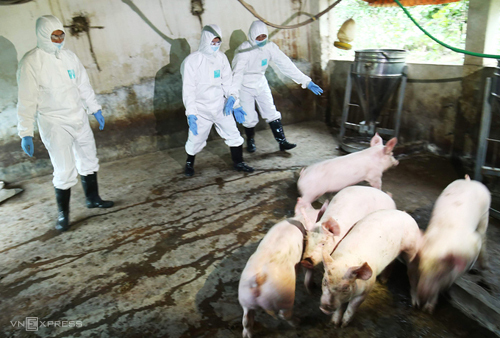
Authorities in Hanoi practice responding to African swine fever.
From the experimental results, Ms. Lan affirmed that the vaccine is safe and highly protective for vaccinated pigs. However, due to the short research and testing time, many experiments have been shortened, so Ms. Lan believes that vaccines need to be further studied on a large scale and repeated, adding more experiments to optimize the formula and quality of the vaccine. Further research is needed to create other, better vaccines.
"The Ministry of Agriculture and Rural Development needs to urgently fund research and production of African swine fever vaccines; organize to help the Academy evaluate the quality of the produced vaccines so that they can be put into production soon," Professor Lan suggested.
At the meeting, representatives of many research groups from enterprises also introduced the initial results of vaccine production and biological products that can be applied to livestock farming to help prevent African swine fever.
Minister of Agriculture and Rural Development Nguyen Xuan Cuong said that the Ministry will direct specialized agencies, in coordination with the Vietnam Academy of Agriculture, to soon develop a process for testing and verifying vaccines in the special circumstances of Vietnam. The Minister also directed that we should not be subjective with the achieved results, and that we need to approach them in the most creative ways to speed up the steps and soon commercialize the vaccines on the market.
Over the past 100 years, scientists around the world have researched and produced 7 strains of African swine fever vaccines (with evaluated efficacy) from attenuated virus strains. However, the commercialization of these vaccines has encountered many difficulties due to the very high production costs, so disease prevention for pig farms with African swine fever has not been implemented. Whenever the disease spreads, the measure applied is to destroy the pig herd.
African swine fever appeared in Vietnam more than 4 months ago and spread rapidly to 60 provinces and cities across the country. Nearly 3 million infected pigs have been destroyed. The epidemic has not shown any signs of slowing down and there is a risk of continuing to spread to the remaining provinces, especially the Mekong Delta region.
Source: vnexpress.net